
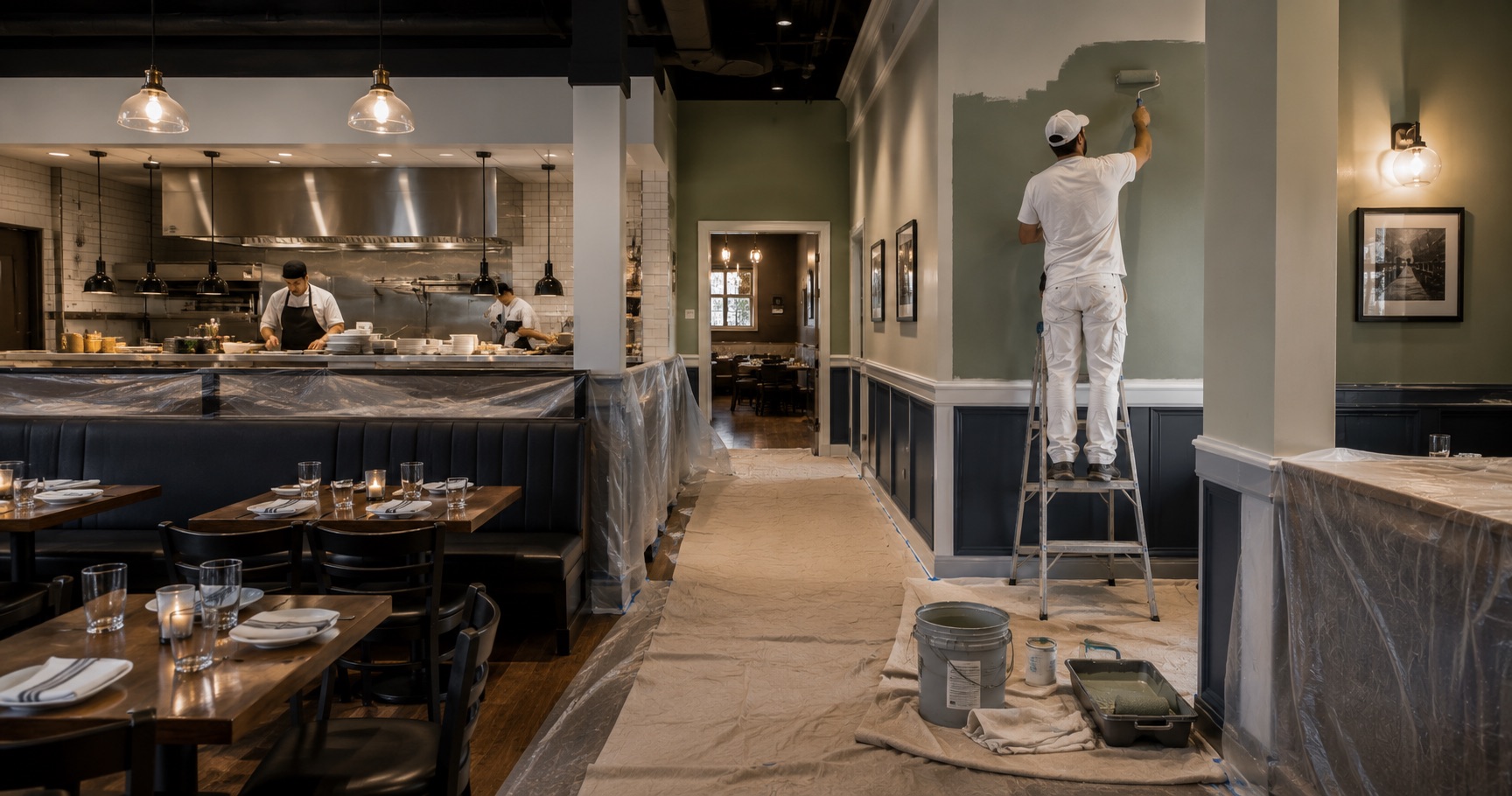
The dining room may close at 10:00 p.m. The paint window does not begin at 10:00.
Guests still have to leave. The kitchen may be cleaning, cooling equipment, counting inventory, or receiving a late delivery. Food, utensils, glassware, and portable equipment have to be removed or secured before a work zone can be released. Morning prep may begin hours before the front door opens again.
That is the scheduling problem behind restaurant painting between service hours. “Closed” and “available to a painting crew” are not the same condition.
AllBright Pro Painting does not begin by promising that every restaurant can be repainted overnight. We begin with the first activity that must happen before the next service and work backward. The resulting plan may use an overnight window, a regular closed day, several isolated phases, or a longer shutdown for a zone that cannot responsibly be returned in one shift.
The paint matters. The handoffs around it decide whether the plan works.
Closed Hours Are Not the Paint Window
A restaurant schedule usually shows service hours. A painting schedule needs more.
Before pricing a between-service project, the walkthrough should identify five separate moments:
- When the last guest is expected to leave the affected zone
- When food operations, cleaning, and equipment use end in that zone
- When the restaurant will release it to the painting crew
- When the painting crew must return it for the restaurant’s inspection and reset
- When food preparation, deliveries, staff setup, or guest service begins again
The usable paint window sits between the third and fourth moments. Protection, surface preparation, coating, ventilation, cleanup, inspection, and any required return visit all have to fit inside that window. The hours before release and after return still belong to the restaurant.
This is why an apparent eight-hour closure can produce a much shorter work period. It is also why a lunch-to-dinner gap that looks available on a calendar may not support painting at all. A useful proposal shows the actual release and return times instead of treating the hours on the front door as the project schedule.
If those times are not known yet, the honest result of the walkthrough may be a list of operational decisions rather than a final price. Guessing at the window only moves the decision to the night of the work, when every option is more expensive.
Map the Restaurant by Use, Not by Wall Color
Two walls painted the same color may require different plans because one is in a dining room and the other is behind a dish line. The first scope decision is therefore a zone map, not a color list.
| Zone | What changes the paint plan | What should be resolved before pricing |
|---|---|---|
| Dining room | Guest-facing finish, furniture movement, artwork, lighting, and sightlines | Which sections can close, who moves furnishings, and what “guest-ready” means |
| Bar | Bottles, glassware, sinks, refrigeration, mounted equipment, and late closing times | Who clears and resets the bar and whether it can be isolated from service |
| Kitchen walls and ceilings | Grease, steam, heat, condensation, aggressive cleaning, and exposed food operations | Exact paintable surfaces, cleaning method, food removal, and release authority |
| Warewashing area | Persistent moisture, splash, cleaners, and limited drying conditions | Whether moisture or substrate failure must be corrected before coating |
| Dry storage | Packaged food, shelving, tight access, and inventory movement | Where inventory will go and whether the room can be fully emptied |
| Restrooms and corridors | Continuous guest need, frequent touchpoints, and limited alternate routes | Whether one area can remain available and how traffic will be redirected |
The map also identifies exclusions. Hood components, fire-suppression equipment, stainless work surfaces, tile, fiberglass-reinforced panels, refrigeration equipment, and movable food equipment are not automatically part of an architectural painting scope because they happen to share a room with a painted wall.
Paint should not be asked to impersonate equipment service, exhaust repair, plumbing, waterproofing, or a new wall system. If another trade owns the failing component, that boundary belongs in the proposal before the schedule is built.
“Food-Safe Paint” Is Not a Complete Specification
The phrase sounds reassuring and says very little by itself.
Tennessee’s food-service rules distinguish food-contact surfaces from the building’s physical facilities. A food-contact surface is generally an equipment or utensil surface that normally touches food or from which material may drain, drip, or splash into food. An ordinary wall or ceiling does not become a direct food-contact surface merely because it is inside a kitchen.
That distinction does not make any architectural coating acceptable anywhere. Tennessee’s rules address the properties and maintenance of floors, walls, and ceilings in food-operation areas. Depending on the location, those surfaces may need to be smooth, durable, easily cleanable, and nonabsorbent, and physical facilities must be kept in good repair. The Tennessee Department of Health Environmental Health program links the current state food-safety rules and identifies the authority responsible for permitting and enforcement.
The FDA Food Code is useful context, but FDA describes it as a model that jurisdictions use to develop or update their own rules. It is not a substitute for the current Tennessee rule, a contract county’s requirements, a franchisor’s standards, or a direction from the environmental health specialist responsible for the establishment.
The coating decision therefore starts with questions, not a label:
- What is the substrate?
- Is this an architectural surface, equipment surface, or food-contact surface?
- Is the area routinely wet, scrubbed, exposed to grease, or subjected to heat?
- Which cleaners will the restaurant use after the project?
- What does the current product documentation allow for that surface and use?
- Does the restaurant or regulatory authority require a particular approval or record?
AllBright Pro Painting owns the paint-side evaluation and should be able to identify the coating, its documented use, and the surfaces included in the proposal. The restaurant’s person in charge and the applicable regulatory authority own the establishment’s food-safety decisions. A painter cannot create regulatory approval by describing a coating as “food safe” in a blog post or estimate.
Peeling Paint Is a Symptom, Not a Complete Diagnosis
Failing paint near exposed food deserves prompt attention because loose material and surfaces that cannot be effectively cleaned can create real concerns. That does not make every lifted edge the same violation or every repair a paint-only job.
The location and shape of the failure help determine the next question:
| What the restaurant sees | What it may indicate | What the observation does not prove |
| Peeling above a dish area | Condensation, repeated splash, an active leak, or a weak existing coating | That a new topcoat will correct the moisture source |
| Dark or soft coating near a cook line | Grease, heat, cleaning residue, or exhaust conditions | That the wall can be coated before it is cleaned and evaluated |
| Failure at one seam or penetration | Movement, failed sealant, or water entering at a specific point | That the entire room needs the same repair |
| Sheets of coating releasing across several walls | Poor adhesion, incompatible layers, trapped contamination, or substrate failure | Who skipped which step on an earlier project |
| Damage on FRP, tile, stainless, or equipment | Failure of a nonpaint surface or its attachment | That architectural paint belongs on it |
Grease can be nearly invisible while still separating a coating from its substrate. Condensation can expose a weak layer without being the original reason that layer was weak. A leak can keep defeating a correct paint system until the water source is repaired.
The right order is diagnosis, correction of the active cause, and then a coating decision. Painting over the symptom may improve the room for a night while preserving the failure underneath.
AllBright Pro Painting should identify what can be corrected within the paint scope and what requires another trade or an authorized restaurant decision. If the condition found after access or cleaning changes the approved scope, added work is priced and documented before it begins. It should not arrive later as unexplained invoice time.
Release the Zone Before the Crew Enters
Plastic sheeting is not a substitute for an operational handoff. The restaurant has control of food, utensils, equipment, and sanitation. The painting contractor has control of its own materials, debris, protection, and work practices. Neither side should silently inherit the other’s decisions.
| Party | Decisions it should make before work begins |
| Restaurant person in charge | Which zone is out of operation, what food must be removed or discarded, how utensils and single-service items are secured, and when the zone is released and accepted back |
| Equipment or specialty vendor | Whether hood, refrigeration, fire-suppression, electrical, plumbing, or other equipment can be moved, covered, shut down, or worked around |
| AllBright Pro Painting | Which architectural surfaces are included, how the work is isolated, what preparation and cleanup are included, and what conditions stop the paint work |
| Regulatory authority or corporate food-safety representative | Any approval, inspection, product record, sanitation condition, or reopening determination the establishment must obtain |
That division matters most when the restaurant wants the work performed above or beside an active prep area. The zone should not be released while exposed food, clean utensils, or unprotected single-service items remain within the work path. The restaurant decides how those items are handled. The painting plan then shows how dust, chips, tools, coatings, and removed protection stay out of the rest of the operation.
A photograph of a cleared counter is useful documentation. It does not transfer food-safety authority to the painter.
Choose the Phase That Fits the Operation
There is no universal restaurant schedule. The useful option is the one that fits the real work window, the coating documentation, the zone’s operating role, and the restaurant’s reset capacity.
| Scheduling pattern | Where it can work | Condition that must be resolved first |
| Overnight phase | A separable dining room, bar section, corridor, or back-of-house zone | The release and return times leave enough room for the complete paint-side scope |
| Regular closed day | Larger sections or work with more preparation and drying time | Deliveries, cleaning, staff access, and vendor visits do not consume the closure |
| Zone rotation | Restaurants that can keep service moving through unaffected rooms | Traffic, food movement, ventilation, and emergency routes remain workable |
| Planned shutdown | Kitchens or widespread failures that cannot be responsibly isolated | The closure accounts for repairs, coating limits, sanitation, and operational restart |
“We will finish overnight” is not a planning method. It is a conclusion that can be reached only after the zone, surface condition, product documentation, crew access, release time, and return standard are known.
A larger crew does not automatically solve a short window. More people need more access, protection, tools, staging space, and supervision. In a tight kitchen, the extra bodies can reduce productive room rather than increase it. AllBright Pro Painting sizes the crew to the phase instead of using headcount as proof that an overnight promise is safe.
Dry, Low Odor, and Ready for Service Are Different Conditions
A low-VOC or zero-VOC label should not be translated into “odorless,” “fully cured,” or “approved for reopening.” Odor perception varies, tinting and product chemistry matter, and the exact label and technical documentation control the application and return-to-use limits for the selected coating.
Dry-to-touch time, recoat time, cure, resistance to cleaning, and restaurant release answer different questions. Our guide to paint drying and curing explains that distinction. A generic internet number should not become a food-service clearance rule.
The ventilation plan also needs an owner. Opening a door, operating an exhaust hood, or changing HVAC settings may affect pest control, temperature, alarms, pressure relationships, neighboring tenants, or equipment procedures. The restaurant or building authority decides which systems may run. The contractor plans the coating work around that decision.
AllBright Pro Painting can report the product used, application time, observed condition, completed cleanup, and manufacturer instructions provided with the project. The restaurant decides when staff, food, utensils, and guests return. If the regulatory authority or a corporate standard requires another condition, that requirement controls over the contractor’s preferred schedule.
Define What “Reset” Means
The old version of this article promised that every work session would end with the space fully reset and odor-free. That language was too broad. A dining-room accent wall and a failing kitchen ceiling do not share one reset standard, and a painting contractor cannot make the restaurant’s reopening decision.
A useful plan names three different handoffs:
Paint-complete
The listed coating stage is complete, paint materials and debris are removed as specified, and the work zone remains secured. The restaurant has not yet accepted the area for food operations or guests.
Ready for restaurant inspection
Contractor protection is removed where the scope requires, paint-side cleanup is complete, labels and requested records are available, and the person in charge can inspect the zone. Food and operational equipment have not been returned by assumption.
Released for service
The restaurant completes its sanitation and reset steps, confirms equipment and food operations, resolves any corporate or regulatory requirement, and authorizes the area to return to use.
Naming the handoffs prevents the restaurant and contractor from using the word “ready” for different conditions. It also gives the morning manager a test more useful than whether the room merely looks finished from the doorway.
What a Restaurant Painting Proposal Should Settle
A restaurant proposal does not need an invented universal food-safety clause. It needs a building-specific record. Before approval, it should identify:
- Included zones, architectural surfaces, and explicit exclusions
- Release and return times for every phase
- Who removes, secures, and returns food, utensils, inventory, and equipment
- Known substrate failures and conditions assigned to another trade
- Preparation, isolation, protection, and paint-side cleanup
- The exact coating system and the documentation relevant to its use and cleaning
- Ventilation authority and any HVAC, hood, alarm, or tenant restrictions
- Paint-complete, inspection-ready, and service-release handoffs
That record belongs beside the restaurant’s own sanitation, operations, and regulatory plan. It does not replace them.
Our commercial interior painting service explains the painting work AllBright Pro Painting performs. This article has a narrower job: show how a restaurant turns the hours between service into a defined, releasable work window. Keeping the two decisions separate prevents a general service description from becoming a food-safety plan.
Build the Plan Around the First Prep Task, Not the Last Guest
The strongest restaurant repainting plan does not begin with a promise to work overnight. It begins with the restaurant’s operating facts.
Bring the service schedule, first prep and delivery times, closed days, zone priorities, known leaks or equipment issues, cleaning products, and any current health-department or corporate requirements to the walkthrough. AllBright Pro Painting can then show which surfaces belong in the paint scope, which decisions must come first, and what each phase can responsibly return before the next service.
The result may be an overnight phase. It may be a closed-day project, a room-by-room sequence, or a repair list that has to be completed before painting. That is not hesitation. It is how the price, schedule, and reopening handoff become usable.
Schedule a restaurant painting walkthrough and bring the real operating calendar. We will build the paint plan around the restaurant that has to reopen, not around an imaginary empty building.