

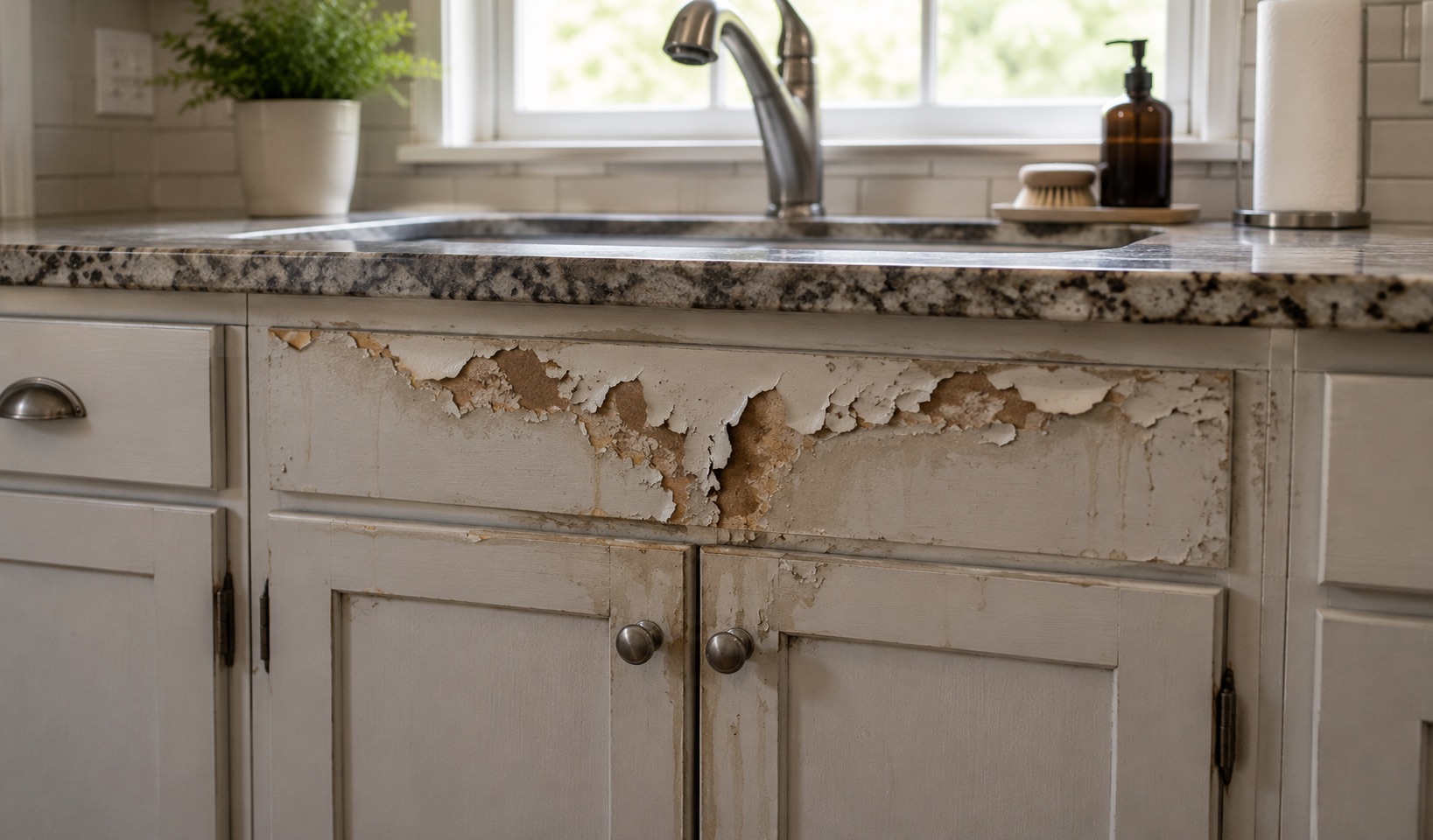
The doors below the sink are often the first place a cabinet finish fails. The next trouble spot may be beside the dishwasher. Meanwhile, the upper doors can still look untouched.
That pattern makes water the obvious suspect. Sometimes water is the cause. Sometimes it is only the stress that exposed an adhesion problem already present across the kitchen.
The difference matters. Touching up a moisture-damaged edge will not solve an active leak. Repainting one door will not solve a coating system that is releasing from every cabinet. Stripping an entire kitchen, however, is unnecessary when the damage is truly local.
Peeling near the sink is a clue. The failure itself still has to be diagnosed.
Why the Sink Cabinet Often Shows the First Failure
A sink base combines repeated handling with frequent water exposure. Wet hands reach for the doors. Small splashes collect near lower edges. Cleaning products run down a face. A slow supply or drain leak can keep the cabinet interior damp without leaving water on the floor.
The dishwasher side of the kitchen can produce a similar pattern. Depending on the appliance and its installation, warm moisture may reach an adjacent door edge or end panel. Repeated opening, closing, and wiping add mechanical wear to the same small areas.
That is why the location is useful. It tells us where the finish faced the most stress. It does not tell us, by itself, why the finish lost its bond.
A well-bonded coating can tolerate normal kitchen use. A finish already weak at an edge, seam, or previous repair gives moisture a path underneath. Once an edge lifts, the next splash can travel farther. Each lifted edge gives the next bit of moisture a way in.
The paint may be separating from a sound cabinet surface. A previous coating may be separating from an older layer. The cabinet material itself may be swollen or breaking apart. Those are three different failures, even when the photograph looks like “peeling paint.”
Four Causes Can Produce the Same Peeling Edge
More than one cause can be present in the same kitchen. Grease may have weakened the original bond, for example, while water near the sink revealed the problem first.
| Possible cause | Pattern that raises the question | What still has to be checked |
|---|---|---|
| Moisture or substrate damage | Failure concentrated at the sink, dishwasher, lower rail, open seam, or swollen edge | Whether there is an active water source and whether the wood, MDF, or panel is still stable |
| Grease, cleaner, or silicone contamination | New finish releases from an otherwise intact surface, often near cooking and washing zones | Whether contamination remained under the coating and how far it extends beyond the visible peel |
| Inadequate adhesion preparation | Coating lifts in sheets or chips from several unrelated high-contact areas | Which layer released, what surface lies beneath it, and whether the same preparation was used across the cabinet run |
| An unsuitable or incompatible coating system | Softness, blocking, rapid hand wear, or repeated edge failure appears in multiple locations | The exact existing products, their compatibility, their condition, and whether the substrate is sound |
The table is a starting point, not a remote diagnosis. A clean-looking break can hide contamination. A wet location can still contain a preparation failure. A soft finish can result from the coating choice, its application, its cure conditions, or a combination of them.
The useful question is not simply, “What paint did they use?” It is, “Which layer failed, and what condition caused that layer to let go?”
Grease Is Invisible Until the Finish Tries to Hold
Grease is easy to underestimate because a cabinet can look clean while carrying a film that interferes with adhesion. Cooking residue travels beyond the range hood. Hands transfer oils to pulls and door edges. Polishes and some household cleaners can leave their own residue.
The eye does not see it. The paint does.
This is common in do-it-yourself projects, but it is not evidence that the homeowner was careless. A homeowner who used leftover wall paint on the cabinets is not careless; they used what they had, and nobody told them cabinets need a different product.
The same courtesy should apply to any failed project. A photograph may show where the coating released. It does not prove who skipped which step. The existing finish, the exposed layer, the failure pattern, and the project history need to agree before anyone assigns a cause.
Cleaning and adhesion preparation matter because they remove or control conditions that can interrupt the bond. The exact method should follow the cabinet material, the existing finish, and the coating system selected for the repair. “Degloss” is not a universal instruction to sand every cabinet the same way. Thermofoil, laminate, factory finishes, previously painted wood, and water-damaged MDF do not present the same surface.
That distinction is one reason diagnosis comes before a repair specification.
Peeling Paint and a Failing Cabinet Are Not the Same Problem
If an edge has already lifted, observe what is underneath without pulling away more material. The exposed surface can change the entire scope.
If the cabinet material remains hard, flat, and dimensionally stable, the problem may be limited to the coating layers. If MDF has swollen, turned fuzzy, or lost its edge profile, coating work alone cannot restore the missing structure. A crumbling sink-base floor or a delaminating door may need carpentry or component replacement before refinishing makes sense.
Thermofoil adds another diagnostic trap. When a vinyl film is lifting from an MDF door, the visible failure is not necessarily paint peeling. Coating the detached film will not reattach it. The door material and the condition beneath the film must be identified before a paint repair is proposed.
The same is true of an active leak. The water source has to be corrected and the cabinet has to return to a stable condition before the finish is rebuilt. A painter can identify evidence of moisture. Plumbing, appliance, countertop, or cabinet repairs may belong to another trade.
Paint should not be asked to hide a substrate problem it cannot solve.
Do Not Diagnose the Product From Wear Alone
Cabinet coatings are exposed to hands, rings, fingernails, cleaning, heat, food, and water in ways wall coatings are not. On cabinets AllBright Pro Painting is called to inspect, an underperforming finish often shows itself first at pulls, corners, and closing edges.
That pattern does not identify the exact product. It shows that the existing system is not surviving the contact and conditions at that location.
An old paint can, invoice, proposal, or product label can help establish what was used. Without that evidence, “latex wall paint” may be a reasonable question but not a proven diagnosis. The coating can also fail because it was applied over an incompatible layer, placed on contamination, handled before it developed sufficient hardness, or built over a layer that was already loose.
The finish is a system. Surface condition, preparation, primer when required, topcoat, application, and handling all affect the result. Replacing only the topcoat name does not correct a weak layer underneath it.
The cabinet painting service page explains the cabinet refinishing process and coating system AllBright Pro Painting currently uses. This article has a narrower job: determine why an existing finish failed and how much of it belongs in the repair scope.
What the Failure Pattern Can Tell You
Before pulling every door, look at the whole kitchen. A pattern is more useful than the worst-looking chip.
| What you observe | What it may suggest | What it does not prove |
| Peeling only at one damaged corner | A localized impact or isolated moisture event | That the entire cabinet run is failing |
| Similar lifting at several pulls and closing edges | A broader adhesion or coating-system problem | Which preparation step or product caused it |
| Swelling, darkening, softness, or an open seam near the sink | Repeated or active moisture exposure | That repainting can save the affected component |
| A soft or tacky feel in several areas | A coating or cure problem worth investigating | The product identity or whether every layer must be removed |
| A prior spot repair peeling around its perimeter | The repair stopped at an unstable edge or did not correct the cause | That all spot repairs are ineffective |
Check both affected and unaffected areas. If similar lifting already appears in multiple locations, the visible sink damage may be only the first symptom. If the surrounding coating is sound and the substrate is stable, the repair may remain local.
When a Localized Repair Is Reasonable
A localized repair may be appropriate when all of the following are true:
- The failure is confined to one small area with a known cause.
- The surrounding finish remains firmly bonded.
- The cabinet material is dry, stable, and repairable.
- The water, hardware, or impact issue has been corrected.
- The existing color, sheen, and texture can be matched closely enough for the homeowner’s expectations.
That final point matters. A technically sound patch can still be visible on an aged or sprayed finish. The repair decision includes appearance as well as adhesion.
A local repair should remove loose material back to a stable edge, address the substrate, and rebuild only over a surface that can support the new system. Painting across the lifted perimeter locks the next failure underneath the repair.
When the Failure Is Systemic
A broader refinish deserves consideration when the problem is no longer one damaged spot. Warning signs include:
- Multiple doors failing in the same contact zones.
- Coating releasing from the same underlying layer across the kitchen.
- Widespread softness, blocking, or rapid wear.
- Contamination that is not limited to the visibly damaged door.
- Several prior touch-ups that failed at their edges.
- Substrate or finish differences that make isolated repairs visibly inconsistent.
When the failure is systemic, repairing the sink door alone may move the next peel a few inches over. The next door still carries the same weak layer.
That does not mean every failed kitchen needs to be stripped to bare wood. Removal should continue only as far as the evidence requires to reach a stable, compatible surface. Some existing layers may be sound. Others may release during testing. The repair scope should follow what is found, not a universal stripping claim written before inspection.
What a Useful Cabinet Repair Scope Should Clarify
A proposal for failed cabinets should make the diagnosis visible. It should not quote an imaginary universal “cabinet respray clause,” and it should not hide every uncertainty inside the word “prep.”
Before work begins, the written scope should clarify:
- Which doors, drawers, frames, panels, or cabinet interiors are included.
- Where the visible failure begins and whether the surrounding finish appears sound.
- Whether moisture or substrate damage must be corrected by another trade first.
- How loose coating, contamination, and unstable edges will be addressed.
- How the existing cabinet material and finish affect primer and coating selection.
- Whether a localized repair can be visually matched or a wider refinish is recommended.
- Which findings could change the scope after removal exposes the underlying layers.
If concealed damage changes the job, added work should be priced and documented before it begins. It should not arrive later as unexplained invoice time.
This is where a diagnosis becomes commercially useful. The homeowner can see whether the estimate addresses the cause or merely covers the symptom.
A Photo Can Start the Diagnosis, but It Cannot Finish It
Good photos can narrow the questions before an on-site visit. Send one close-up of the lifted edge, one view showing the full door or drawer, and one wider photograph showing its position relative to the sink, dishwasher, or stove. If the coating has already released, include the exposed surface without pulling away more material.
Project history helps too:
- When were the cabinets last finished?
- Did the failure appear suddenly or spread over time?
- Has there been a leak, spill, appliance issue, or countertop repair?
- Does the finish feel hard, soft, tacky, or brittle elsewhere?
- Are the same symptoms present on doors away from the sink?
- What cleaners or polishes are normally used?
A photograph cannot confirm the bond beneath an entire cabinet run. It can help AllBright Pro Painting avoid beginning with the wrong theory.
The Bottom Line
Cabinet paint often peels near the sink because that area receives concentrated water, handling, and cleaning. But the location alone cannot separate moisture damage from contamination, weak preparation, an incompatible coating system, or a failing substrate.
Look for the layer that released. Check whether the cabinet beneath it is stable. Compare the damaged door with the rest of the kitchen. Then decide whether the evidence supports a localized repair or shows a system-wide problem.
AllBright Pro Painting diagnoses the failure before pricing the fix. If your cabinets are peeling near the sink, send the photos or schedule an on-site estimate, or call 615-987-8011. If a small repair is the sensible answer, that is the scope the evidence should support. If the failure extends across the cabinet run, the estimate should show why.