

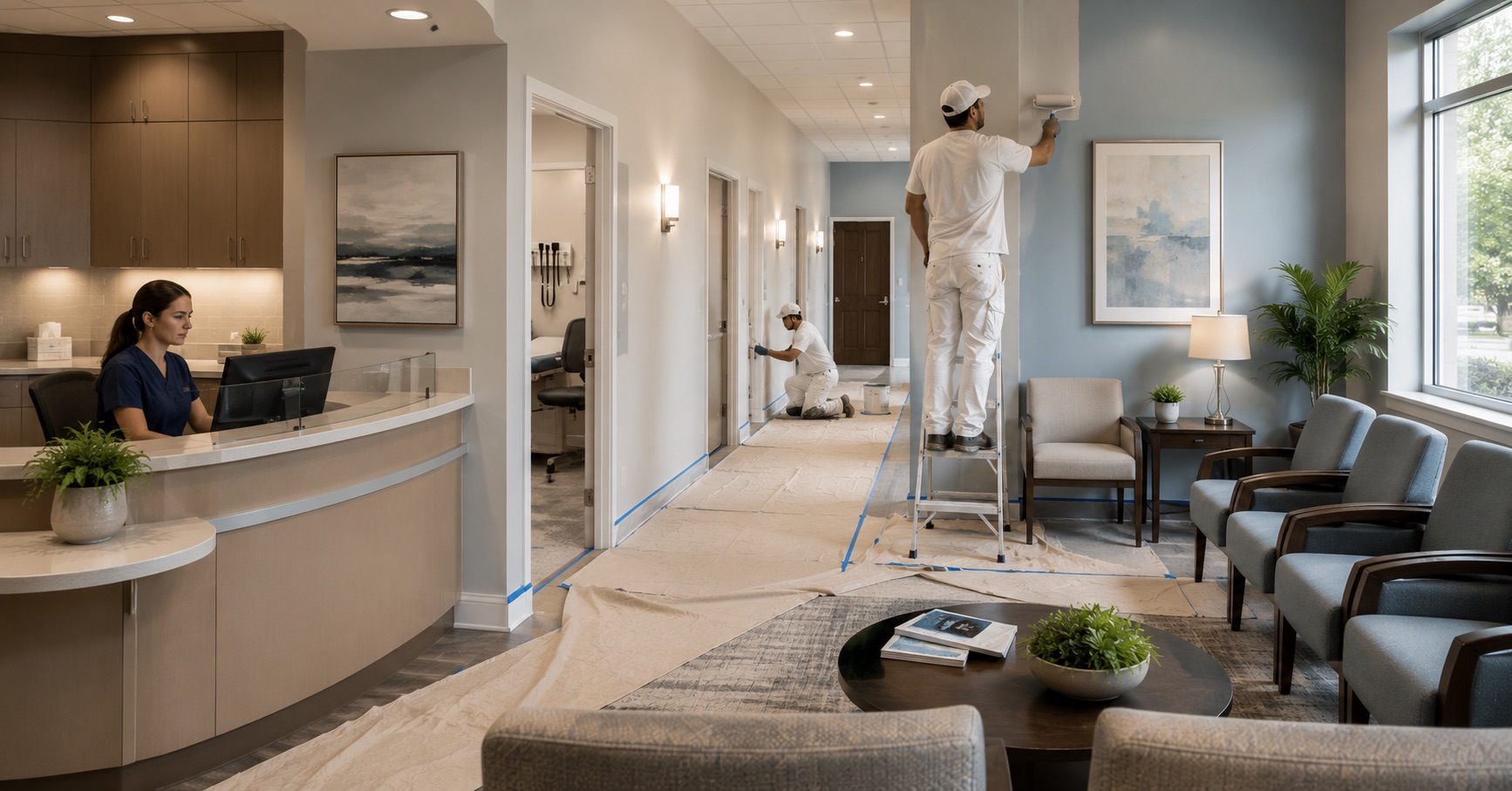
A painter does not need a patient’s diagnosis to repaint an exam room. If the project plan exposes one anyway, the problem began before anyone opened a paint can.
The useful planning question is not whether a contractor can promise a “HIPAA-compliant paint job.” Paint contractors do not certify a medical practice’s HIPAA compliance. The question is whether the practice can give the crew the physical access it needs without giving it access to protected health information, clinical systems, patients, or areas outside the approved scope.
That distinction changes the walkthrough. A practice manager is not merely pointing out walls. The manager is deciding which rooms can be released, what must be secured first, who controls keys and alarms, whether project photographs are allowed, when patient care can resume, and which building-management rules apply to a leased suite.
AllBright Pro Painting can own the paint-side plan it agrees to perform. The practice retains its privacy, clinical, and reentry decisions. The landlord or property manager controls the building functions within its authority. A workable medical office repaint makes those boundaries visible before the first after-hours shift.
Business Associate Status Follows the Function
Possible contact with protected health information is too broad a test for requiring a Business Associate Agreement. The function performed and the access it requires are what matter.
HHS explains that business-associate status depends on the function being performed. Its guidance says plumbers, electricians, and photocopier technicians generally are not business associates when their services do not require the use or disclosure of PHI and any exposure is merely incidental. HHS gives similar guidance for janitorial work. Review the agency’s technician and repair-service FAQ and incidental-access FAQ.
Applying that reasoning to an ordinary painting scope is an inference, not a legal determination about every project. A painting contractor typically should not need PHI to prepare or coat walls. But the practice’s privacy officer, counsel, or other authorized decision-maker must classify the actual arrangement. A contractor cannot settle the issue by declaring itself outside HIPAA, and a website cannot create or waive a BAA requirement.
The better project test is practical:
Does the painting service require the contractor to create, receive, maintain, transmit, use, or disclose PHI?
Will the crew need routine access to records, systems, or patient-information areas rather than merely working nearby?
Has the practice structured the work so the contractor can complete it without PHI?
What practice policy, agreement, supervision, or access control applies to the arrangement?
If the contractor needs a patient list to know which rooms are available, the schedule is carrying information it should not need. Room numbers, release status, work zones, and time windows provide the necessary instructions. A paint plan should depend on building facts, not patient facts.
Turn Privacy Requirements Into Room-Release Rules
HIPAA requires regulated entities to use reasonable safeguards. HHS explains that those safeguards vary with the entity’s circumstances and do not have to eliminate every possibility of incidental exposure. The agency also says the Privacy Rule does not universally require private rooms, facility reconstruction, or soundproof walls. See its guidance on incidental uses and reasonable safeguards and medical-office structural changes.
Open charts and active screens remain unacceptable conditions for releasing a room. The practice determines the safeguards its operations require instead of relying on a generic contractor rule.
Before release to the painting crew, each work area should receive a status the practice defines:
| Area status | Practice action | Contractor permission |
|---|---|---|
| Not released | Patients, PHI, clinical work, or an unresolved security condition remains | No entry and no photography |
| Released with limits | The practice has secured information but a route, cabinet, device, or adjacent room remains restricted | Enter only the marked zone under the stated conditions |
| Released for work | The practice has completed its privacy and clinical clearance for the agreed period | Perform only the documented paint scope |
| Returned to practice | Paint-side inspection and cleanup are complete, and the practice has accepted the handoff | Access ends unless a new release is recorded |
This is more reliable than labeling an entire floor “HIPAA” or “non-HIPAA.” A reception wall may be available after the desk is cleared and screens are secured. A storage room may remain restricted even when no patient is present. The practice, not the painter, makes that classification.
Map Information and Devices Before Mapping Paint
The privacy walk should happen before equipment and materials enter the suite. It identifies what the practice must secure and what the crew must avoid.
The review should include more than paper charts:
Computer screens, tablets, printers, fax machines, and label printers
Whiteboards, appointment boards, door signs, and temporary notes
Paper records, billing material, insurance documents, and prescription information
Specimen labels, medication storage, and clinical equipment with identifying information
Voicemail playback, overhead announcements, and conversations that may continue near the work zone
Cameras, photographs, and video systems used for either the practice or the project
Devices or media that cannot simply be covered, unplugged, or moved by the painting crew
HHS describes physical safeguards for electronic PHI as measures, policies, and procedures that protect electronic systems and related buildings and equipment from hazards and unauthorized intrusion. Those safeguards include facility access, workstation, and device-and-media controls. The HHS physical-safeguards overview leaves the implementation with the regulated entity.
The contractor should not decide that turning a monitor toward the wall is sufficient, that a covered cabinet may be moved, or that a workstation can be unplugged. The practice secures or releases the item. The painting plan records the resulting boundary.
With directly employed crews and a designated project manager, AllBright Pro Painting can give the practice identifiable contacts for access instructions and handoffs. That operating structure does not replace the practice’s safeguards. It makes the approved instructions easier to assign and verify.
Project Photography Needs Its Own Rule
Painting contractors use photographs to document existing conditions, colors, protection, progress, and completed work. In a medical office, an ordinary documentation habit can become a privacy problem if a screen, chart, label, patient, or conversation enters the frame.
AllBright Pro Painting normally uses project photography as part of job documentation. The practice should therefore approve a medical-office photo protocol before work starts rather than discovering the issue when the first image is taken.
The protocol should state:
Which rooms may be photographed.
Who confirms that the room is clear before photography.
Which devices, documents, labels, doors, and reflective surfaces must remain outside the frame.
Whether location, audio, video, or cloud-synced capture is restricted by practice policy.
Who reviews an image if an unexpected identifier may have been captured.
What happens when a condition needs documentation but the practice has not released the area for photography.
The default should be that a paint-condition photograph contains paint conditions, not patient information. If the practice needs a special record involving a sensitive area, its authorized representative should control that documentation. The painter should not improvise a privacy exception for the sake of proving a wall defect.
After-Hours Work Does Not Solve Privacy by Itself
An empty waiting room is not necessarily a released waiting room. Screens may remain on. Printed schedules may sit at the front desk. Records may be stored in the work area. A cleaning crew, answering service, provider, or on-call employee may still enter the suite.
After-hours work can reduce conflict with patient care, but it is one scheduling option, not the medical-office rule.
| Scheduling approach | When it can work | What must be settled first |
| Evening shift | A defined zone can be released after the last appointment | Late-patient procedure, access time, PHI clearance, ventilation, and morning handoff |
| Weekend or closed-day block | Connected rooms need uninterrupted preparation and coating | Alarm access, HVAC schedule, building rules, cure stage, and final inspection |
| Room rotation during operations | The layout separates the work zone from patients and staff circulation | Clinical approval, containment, route control, noise, and release of each room |
| Temporary service relocation | The practice can move a function without exposing information or disrupting care | IT, phone, records, equipment, signage, and patient-communication plan |
The crew should receive operational information such as room availability, approved routes, work windows, and release status. Patient names, diagnoses, appointment reasons, and copies of the clinical schedule stay outside the paint plan.
A late appointment also needs a stop rule. If the practice has not released the room by the agreed time, does the crew wait, move to another approved area, or reschedule that phase? Answering in advance protects both the patient schedule and the project budget.
Morning-Ready Is a Defined Handoff, Not an Overnight Promise
An overnight window needs a product-specific and room-specific handoff. The words “low VOC,” “zero VOC,” and “after hours” cannot prove that the area will be completed, ventilated, odor-free, and suitable for the next appointment.
A product label does not by itself determine whether a clinical room is ready for a particular patient population. Low odor is not the same as odorless. Dry to the touch is not the same as ready for cleaning, equipment contact, or normal service. Ventilation, temperature, humidity, coating system, room volume, maintenance products, and the practice’s own clinical policies can all affect the handoff.
The exact primer, patching material, caulk, coating, and cleaner interaction should be reviewed before scheduling. The contractor provides current product data and application information. The practice identifies any environmental, clinical, infection-control, procurement, or reentry standard it requires. The distinction between drying, recoating, and curing is covered in how long paint takes to cure versus dry; a generic dry-time number should not become a clinical clearance rule.
A morning-ready handoff should say what is actually being accepted:
The agreed coating stage is complete.
Materials, tools, coverings, and debris have been removed from the released route and room as specified.
Wet-paint, access, and other required warnings remain where appropriate.
The contractor has completed the agreed paint-side inspection and cleaning.
The practice has received any product or condition information required for its decision.
The practice’s authorized representative decides whether clinical use resumes.
Some phases will fit between closing and opening. Others will need a longer block or a different sequence. Defining the handoff before pricing is more credible than promising that every room will be normal by morning.
Dust Control May Require Clinical Input
Surface preparation can create a different concern from the coating itself. Sanding, scraping, cutting, opening ceiling spaces, or disturbing damaged material may generate dust or affect air movement. The correct response depends on the work and the patients or clinical functions nearby.
CDC guidance for healthcare renovation says dust and moisture risks should be assessed early and describes infection-control risk assessment as a way to determine suitable containment for construction or repair work. It also notes that location, adjacent patient-care areas, airflow, traffic, cleanup, and clinical risk influence the controls. See the CDC’s environmental infection-control guidance for renovation work.
The practice scales those controls to the setting. A routine exam-room repaint may require less than a hospital renovation, while work beside vulnerable patients or shared air systems may require more. Ordinary plastic and a vacuum are not a clinical determination.
The practice should identify whether its infection-prevention professional, facility policy, accrediting requirements, patient population, or specific clinical use requires an assessment or particular controls. The contractor then prices and performs the paint-side containment, route, cleaning, and documentation included in the approved plan. If the required control is outside the contractor’s service or competence, that limitation should appear before the project starts.
Separate Building Access From Clinical-Suite Release
Medical-office leases and building policies vary. Building management and the practice may control different approvals even when both relate to the same evening shift.
| Party | Decisions it may control for the project |
| Building management | Contractor registration and insurance documents; loading, elevator, common-area, and waste routes; after-hours entry; security procedures; HVAC schedules; applicable building notifications; common-area protection |
| Medical practice | Release of the suite and individual rooms; patient, workforce, and PHI safeguards; clinical equipment and restricted areas; product approval; patient-care scheduling; reentry; acceptance of each handoff |
| Painting contractor | Crew instructions, protection, materials, work-zone control, cleanup, and reporting within the approved scope |
One party’s approval does not substitute for another’s. A building key does not authorize entry into a room the practice has not released. Practice approval does not waive elevator reservations or alarm procedures controlled by management. A landlord’s HVAC schedule does not decide when patients may return.
The proposal should identify who obtains each approval and the deadline for doing so. That avoids the familiar 7:00 p.m. discovery that the crew can enter the building but cannot disarm the suite, use the freight elevator, or keep ventilation operating during the coating window.
Pediatric Offices May Have a Second Regulatory Question
For medical offices, this guide stays with privacy, contractor access, clinical continuity, and tenant coordination. Some pediatric settings also require a separate lead-rule and child-occupied-facility analysis.
A pediatric office is not automatically an EPA child-occupied facility merely because it treats children. Building age and the EPA’s specific visit thresholds matter. If the proposed work is in a pediatric practice or another child-centered setting, use the separate guide to painting a daycare or pediatric office to screen that question. Keeping the analyses separate prevents HIPAA planning from being mistaken for an EPA lead determination.
What the Medical Office Painting Proposal Should Show
Replace a generic “HIPAA-compliant painting” clause with project-specific decisions that the practice, contractor, and building manager can verify.
Before signing, look for:
Included rooms, surfaces, preparation, products, colors, sheens, and exclusions.
The room-release method, restricted zones, crew routes, and authorized practice contact.
The practice’s determination about vendor classification, agreements, supervision, and access controls.
The project-photography rule and response to an unintended capture.
The work window, late-patient stop rule, phase sequence, and process for documenting schedule or scope changes.
Dust containment, airflow, cleaning, and clinical or infection-control conditions supplied by the practice.
Product documents, cure considerations, and the person who decides reentry.
Landlord approvals, building access, HVAC, alarm, elevator, and common-area responsibilities.
The paint-side completion standard and the practice’s acceptance procedure at each handoff.
That list makes the estimate commercial rather than ceremonial. It tells the practice what operational problem the price solves and tells the contractor what information it does not need.
Use the interior commercial painting service page to evaluate the broader commercial interior service AllBright Pro Painting provides. Use this guide when the decision turns on privacy boundaries, clinical access, patient continuity, and landlord coordination inside a medical suite.
The Bottom Line
A sound medical-office plan releases each work zone, secures PHI and clinical systems, establishes photography rules, identifies the patient-care and infection-control conditions, and assigns reentry to the practice. Building management supplies the access rules within its authority. The contractor performs the approved paint scope without making patient information part of the job.
AllBright Pro Painting can walk the office with the practice’s designated representative, document the paintable scope, identify the access and handoff decisions still missing, and coordinate its work window with approved building procedures. An estimate should follow those decisions rather than conceal their absence. If room release, clinical containment, or landlord access remains unresolved, the walkthrough should return that issue to the correct decision-maker before pricing rests on an assumption.
To plan a medical office repaint in Middle Tennessee, schedule a commercial painting estimate or call 615-987-8011. Bring the operating hours, a room-release contact, applicable building rules, and any product or infection-control requirements the contractor must price. Leave patient schedules and PHI out of the paint packet.