

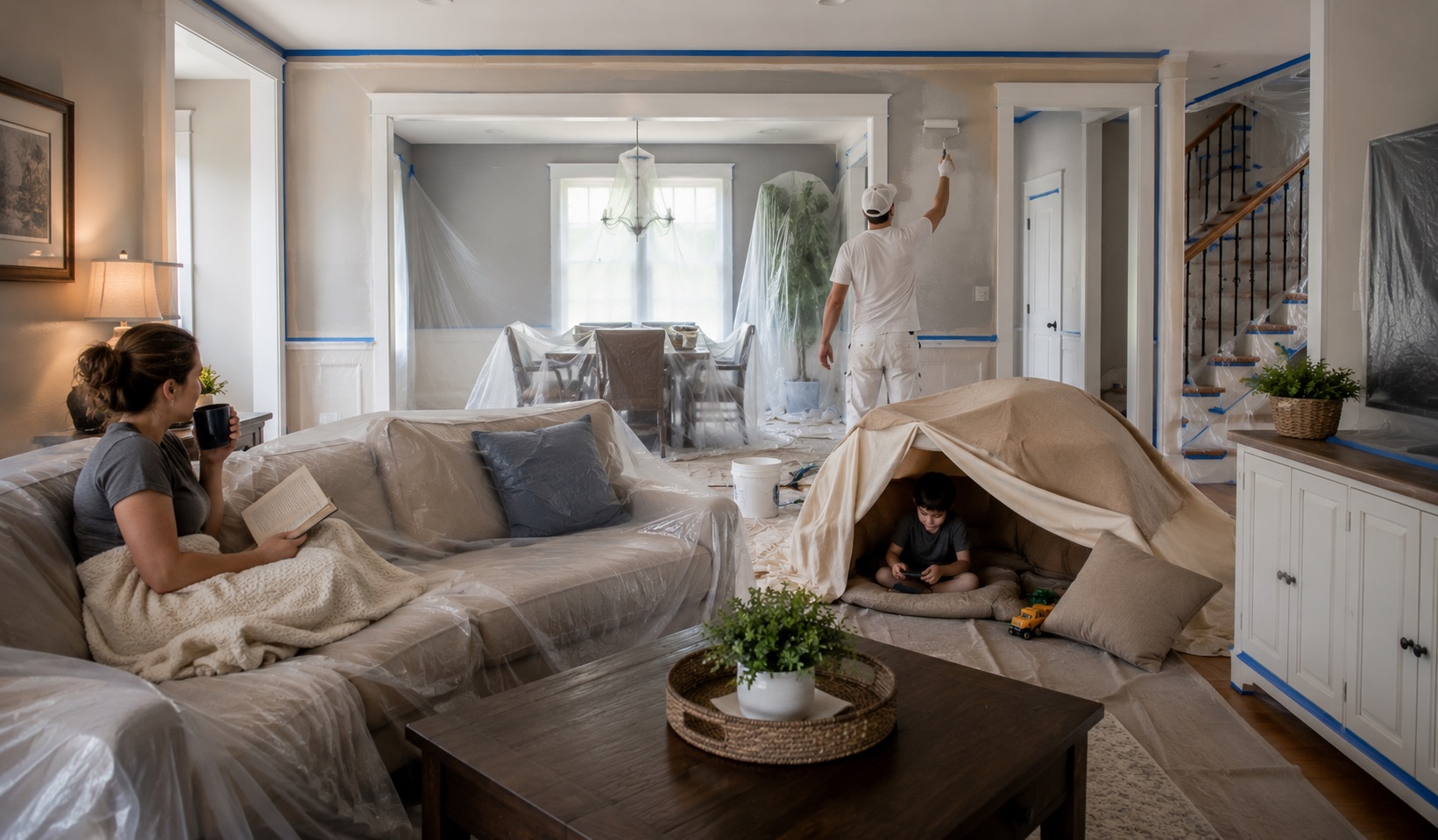
At 3:30 in the afternoon, school bags still land on the kitchen counter. A laptop is still open in the office. The dog still needs to cross the house without meeting a wet door frame.
That is the real test of an occupied-home paint project. The question is not whether a family can technically remain inside. It is whether the work can move through the house without taking the kitchen, every bathroom, the quietest work area, and everyone’s sleeping space at the same time.
Many families can stay home while interior painting is underway. Whether that works in your house depends on the scope, layout, products, ventilation needs, household sensitivities, and whether the contractor builds the room order around the people who still live there.
AllBright Pro Painting has completed 2,100+ residential and commercial projects across Nashville and Middle Tennessee since 2015. On occupied interior projects, we treat the household plan as part of production, not as a favor worked out in the hallway after the crew arrives.
This article begins when work begins. If you are deciding what to move, clean, secure, or leave alone beforehand, use our guide to preparing your home the week before painters arrive. Here, the subject is what happens after the front door opens on painting day.
Can You Stay Home During Interior Painting?
Usually, if the project can preserve three things:
- A clean route between the rooms your household still needs
- A usable bathroom and a practical meal plan
- A closed, inactive space for work, sleep, children, or pets
Those conditions matter more than the size of the house. A large home can still be difficult to occupy if every bedroom is opened at once. A smaller home can remain workable if one side is completed and released before the other side begins.
The decision should be made before the first day, not after furniture is covered and doors are taped.
| Household condition | Practical plan | What must be settled before the start |
|---|---|---|
| At least one bathroom and one closed room can stay outside the active work zone | Staying home is usually workable | Daily access route and room sequence |
| Someone works from home but has no room away from sanding, vacuuming, or frequent crew traffic | Plan to work elsewhere during the louder phase | Which days contain disruptive preparation |
| Every bedroom or the only bathroom is in the same phase | Consider an overnight alternative | When essential rooms will be unavailable and released |
| A baby, young child, or medically sensitive person may be affected by the products or ventilation conditions | Make the decision with the person’s clinician and the exact product information | Product label, safety data, ventilation plan, and sleeping location |
| A dog or cat cannot remain securely separated from the work path | Arrange off-site care or another secure plan | Who is responsible for the animal and where it will remain |
Sometimes leaving for part of the project is the better answer. A contractor should be willing to say that before selling you a version of the week that your floor plan cannot support.
The Project Is Livable Only If the Room Sequence Is
In an occupied home, room order doubles as a temporary operating plan.
The sequence requires more than a list of included walls. We need to know which bathroom is essential, where someone takes calls and whether a child naps during the day. The dog’s usual exterior door and any bedroom that must remain untouched until another is ready also affect the order.
A workable itinerary answers five practical questions:
- Where will the household spend the workday?
- Which route can people use without crossing the active zone?
- Where will everyone sleep that night?
- Which bathroom and meal setup remain available?
- What has to be confirmed before a completed room returns to normal use?
When the layout and scope allow it, AllBright Pro Painting organizes the work to preserve a usable bathroom and a workable meal plan. When that is not possible, the limitation belongs in the plan before the start date.
What a Five-Day Interior Painting Week Can Look Like
There is no standard five-day sequence that fits every home. Room count, repairs, trim, ceilings, colors, products, drying conditions, and crew size all change the schedule. The table below is an example of sequencing logic, not a promise that these rooms or dates apply to your project.
| Example day | Active work zone | How the household operates around it | End-of-day decision |
| Day 1 | Living and dining areas | Bedrooms, kitchen, bathroom, and an office remain outside the work zone | Which common areas are released, and which boundaries remain |
| Day 2 | Hall and secondary bathroom | The household uses the alternate bathroom and an agreed route through the house | Whether the hall can reopen and which bathroom remains restricted |
| Day 3 | Primary bedroom and closet | Sleeping arrangements move to a room completed earlier or excluded from the scope | When bedding and normal bedroom use can return |
| Day 4 | Secondary bedrooms | Children use the prearranged sleep and homework space | Which rooms are ready and which still need protection |
| Day 5 | Kitchen or final bathroom phase | Meals and bathroom access follow the backup plan agreed before work began | Final access, touchups, cleanup, and aftercare instructions |
The sequence is valuable because it exposes conflicts early. If Day 3 removes the only quiet office on the same day Day 4 requires a child to use the living room, the itinerary is not finished. The fix might be changing the room order, splitting a phase, or planning one day away from the house.
That is a better conversation to have during scheduling than at 8:15 on the morning the room is supposed to begin.
Day 1: The House Learns Its New Boundaries
The first day usually feels busiest even when the active area is limited. Crew members are establishing protection, carrying equipment, confirming the written scope, and separating work paths from household paths.
The most useful first-day walkthrough is brief and specific. Identify the room being worked in, the bathroom and entrance the family will use, the door that must remain closed for a pet, and any time-sensitive call or school return. Everyone should know which space belongs to the crew and which space stays with the household.
Day 2: The Routine Becomes Predictable
By the second day, the active zone changes but the communication pattern should be familiar. You should know what room is next, what will be noisy, what route remains open, and what the crew expects to release at the end of the day. If you are still asking where you can walk each morning, the schedule is listing rooms without managing occupancy.
Day 3: Sleep Becomes the Planning Test
Bedrooms make weak sequencing visible. It is easy to say that a bedroom is “being painted Wednesday.” The useful plan says where that person sleeps, where clothing and medication will be accessible, and who confirms when the room can return to use.
Do not base the sleep decision on a generic internet dry-time number. The product, work performed, ventilation, conditions, and individual household needs all matter. The product instructions and project-specific handoff control.
Day 4: Children and Pets Test the Traffic Plan
Children do not always remember that a familiar hall has become a work path. Pets do not understand tape lines at all. On the days when work moves closer to bedrooms or family spaces, physical separation matters more than reminders.
Closed doors, a gate outside the active path, an off-site pet plan, or an adult-controlled route is more reliable than asking the crew to watch for an animal while carrying tools and materials.
Day 5: Completion Is More Than the Last Coat
The final-day handoff should separate completed work from normal household use. A vague statement that everything is done cannot make that distinction.
Ask what can be touched, cleaned, closed, slept in, or placed back into service, and when. Those are not all the same question. Our separate article on paint drying versus curing covers the aftercare decisions that begin after the crew leaves.
Working From Home While the Crew Is Painting
Most wall application is not the loudest part of an interior project. Preparation, sanding, vacuuming, ladder movement, equipment setup, and occasional repair work are more likely to interrupt a call.
Working from home therefore depends on the schedule and the amount of physical separation the house provides.
Choose a work room that is excluded from the active phase and, when possible, away from the crew’s travel path. Tell the project manager about presentations, client calls, recording sessions, or other windows that cannot tolerate interruption. The schedule may be able to place quieter work around them, but the arrangement should be confirmed rather than assumed.
A normal crew day includes conversation, tool movement, and sometimes music at a low level. Low music may be ordinary, but it should not outrank the household. Say what you need before the day begins.
If uninterrupted silence is essential and the floor plan offers no real separation, working elsewhere during surface preparation is usually more realistic than expecting an active jobsite to sound like an empty house.
What Paint Odor Can and Cannot Tell You
Odor varies by product, color, ventilation, room size, and individual sensitivity. A low-odor or zero-VOC label should not be translated into “odorless,” and a room that smells mild should not automatically be treated as ready for every person to occupy.
The U.S. Environmental Protection Agency advises residents and painters to follow the specific product label, provide outdoor ventilation, and recognize that susceptibility varies. Its healthy indoor painting guidance also advises keeping young children and people with breathing problems away from freshly painted rooms and leaving the area if symptoms such as eye irritation, headache, dizziness, or breathing difficulty occur.
For an occupied project, the practical process is:
- Confirm the exact product before work begins.
- Review its label and safety information instead of relying on a broad product-family claim.
- Decide how the work zone will be ventilated to the outdoors.
- Keep the active room separated from the rest of the household where the layout permits.
- Give medically sensitive household members’ needs priority over the preferred schedule.
Ventilation is also project-specific. Opening a window may help move air outdoors, but weather, airborne dust, pollen, security, and the finish process can affect when and how it is done. The answer is a written plan for the actual room and product, not “we always open every window” or “the smell will be gone tonight.”
Children, Pets, and Sleeping Arrangements
For children’s rooms, decide before the project where the child will sleep and which belongings must remain accessible. Do not wait until the bed is covered to discover that a school uniform, medication, or bedtime item is inside the active zone. A young child should not be expected to remember that a familiar room is temporarily restricted.
For infants, people with breathing conditions, or anyone with a known sensitivity, tell AllBright Pro Painting during the estimate and scheduling process. We can discuss product and sequencing options, but medical advice belongs to the person’s clinician. If the household needs to be away for part of the work, the room order should be built around that decision.
Dogs should be crated, kept behind a secure closed door away from the work path, or cared for off-site. Cats need a designated closed room and a clear note that no one opens that door without the homeowner’s direction. The painting crew can respect the boundary, but it cannot replace the household’s containment plan.
The same principle applies to sleep: no universal rule can promise that a newly painted bedroom is appropriate for every person that night. Use the product instructions, ventilation plan, work performed, and any medical guidance to make that decision.
The Daily Handoff Makes Staying Home Work
At the end of each workday, the update should answer:
| Daily question | Why it matters |
| What was completed today? | The household knows whether the project is tracking to the agreed sequence |
| Which rooms or surfaces remain restricted? | “Finished painting” is not confused with permission for normal use |
| What can the household use tonight? | Meals, bathroom access, work, and sleep remain practical |
| What begins tomorrow? | People can move plans, children, and pets before the crew arrives |
| Did the sequence or scope change? | Added work or a reordered room does not become a surprise later |
AllBright Pro Painting assigns a project manager to oversee the work through the final walkthrough and uses CompanyCam for timestamped project updates. For an occupied home, those updates should do more than document progress. They should help the family understand the next day.
A useful message is not “Day 2 complete.” It is “the hall remains restricted tonight, the primary bathroom is available, and the crew begins the secondary bedrooms tomorrow.” One reports production. The other lets a family live around it.
When Leaving the House Is the Better Plan
Staying home is not a measure of project quality, and leaving is not a failure of planning. Some scopes simply place too many essential spaces inside the work zone.
Consider being away for a day or arranging an overnight stay when:
- The only bathroom will be unavailable
- Every practical sleeping area is in the same phase
- Extensive preparation or a particular application method makes separation unrealistic
- A household member’s clinician recommends avoiding the environment
- A pet cannot be safely contained away from the crew’s path
- The project is intentionally compressed and the household cannot retain a stable zone
A lower-disruption schedule may take longer. A compressed schedule may require the family to leave. Neither is automatically better. The right choice depends on whether speed or continued occupancy matters more for that household.
AllBright Pro Painting would rather identify that tradeoff before the estimate becomes a production calendar than promise that every family can stay through every interior scope.
Ask for an Occupancy Plan, Not Just a Start Date
An interior painting proposal tells you what will be painted. Before an occupied project starts, you also need to know how the house will function while that work moves from room to room.
Bring the contractor your floor plan, work calendar, bathroom constraints, sleeping needs, and pet arrangement. Then ask for a day-by-day answer to three questions: what is active, what stays usable, and what changes tomorrow.
AllBright Pro Painting uses directly employed W-2 crews rather than subcontractors, with a project manager responsible for the work through final walkthrough. That structure supports consistent daily coordination, but the itinerary still has to be built for your house. For scope, surfaces, products, and the estimate process, visit our interior house painting service.
If the layout supports staying home, we will show you how the sequence works. If it does not, we will tell you where the conflict is so you can plan around it before painting day.
Schedule a free estimate with AllBright Pro Painting and bring the household constraints that matter as much as the walls.