

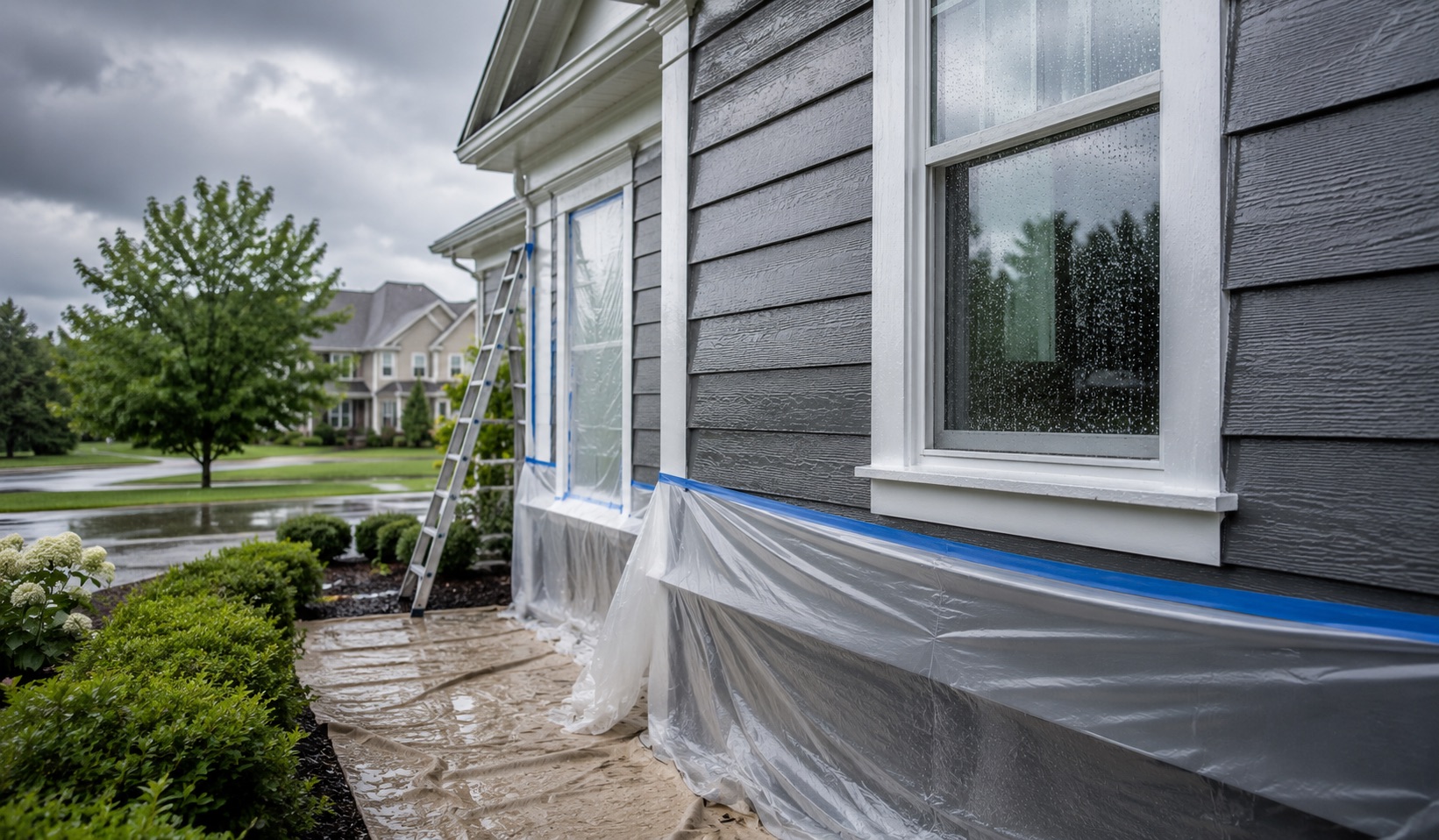
The radar can be wrong without the painter becoming helpless.
A dry morning in Brentwood can turn into an afternoon storm. Once that happens, the useful questions are no longer whether the forecast changed or who refreshed the app last. The crew needs to know which surfaces were coated, when the application stopped, which product is on the wall, how the exposed film looks after drying, and what conditions are required before work resumes.
Rain may cost a working window. It should not erase the record of what happened.
AllBright’s response is built around that distinction. Conditions are monitored before exterior work, and application stops when the available window is no longer defensible. The affected stage is documented, exposed surfaces are inspected after drying, and the homeowner receives the schedule update. The coating system and actual conditions decide the next step. A generic percentage on a weather app does not.
Rain Changes the Workday Before It Changes the Paint
A forecasted shower and rain on uncured coating are different events.
When the risk appears before application, the crew can delay a coat, continue with suitable non-coating tasks, or move the workday. Nothing has failed. The schedule has responded to a condition the finish cannot control.
When rain reaches newly applied paint, the project moves from prevention to inspection. The exposed section may show no visible change, a removable surface residue, uneven film, or an adhesion concern. The correct response cannot be chosen from the forecast alone because the product, substrate, elapsed time, temperature, humidity, wind, and amount of water all affect the outcome.
A responsible weather plan uses the chance of rain as one input. It may cancel a day, shorten the application area, or leave suitable preparation work available. The decision belongs to the actual work window.
Middle Tennessee’s Exterior Season Is a Schedule, Not a Guarantee
AllBright typically schedules exterior painting from late March through mid-November. That is the company’s published operating season, not a claim that every day inside it is paintable.
Some spring days are too wet. Some summer elevations are too hot or exposed for the planned application. Cool nights, dew, wind, shade, humidity, and a late forecast change can narrow an otherwise usable day. The crew may work one elevation and leave another alone because the two surfaces are not experiencing the same conditions.
Calendar dates therefore answer only when exterior projects are generally scheduled. The daily go-or-pause decision still depends on the product instructions and surface conditions at the property. If those do not support the work, AllBright Pro Painting would rather move the application than make the house absorb the risk.
AllBright’s normal residential exterior season ends in mid-November. Any unusual scope outside that window would require its own condition and product review; it is not the standard promised by this page.
There Is No Universal Rain-Safe Number for Exterior Paint
Dry time, recoat time, cure development, and early moisture resistance are related but not interchangeable. The exact product matters.
AllBright’s published exterior range includes Sherwin-Williams Duration and PPG Permanizer. Sherwin-Williams currently describes Duration Exterior as suitable for low-temperature application and publishes product-specific technical data. PPG describes Permanizer as having early moisture resistance. Neither statement gives a contractor permission to invent one rain rule for every color, sheen, substrate, coat, and weather condition.
The working sequence is more disciplined:
Identify the exact coating selected for the surface.
Read its current label and technical data for application and drying conditions.
Compare those requirements with the forecast and measured conditions at the house.
Preserve enough weather margin for the planned coat instead of aiming at the last theoretical minute.
Recheck before another coat or another elevation begins.
The broader distinction between a coating being dry and continuing to cure is covered in Paint Dry vs. Cure: How Long Until You Can Use the Room?. For an exterior rain decision, the manufacturer’s instructions for the actual product control. This page will not replace them with a single fixed-hour rule.
What AllBright Checks Before Exterior Application Begins
Weather management starts before a ladder or spray rig is positioned. The project team needs a usable window for the specific surface and coating stage, not merely an icon showing a sun.
The pre-application check considers:
The current forecast and the direction and timing of approaching weather
Whether the substrate is dry enough for the planned primer, paint, or stain
Temperature, humidity, wind, shade, and sun exposure at the working elevation
The current product label and technical data
Whether the crew is starting a first coat, recoat, repair, or detail section
How quickly the active area can be stopped and secured if conditions change
Irrigation, roof runoff, condensation, and other water exposure not shown by radar
The remaining daylight and drying window after application
Together, these factors decide the day. Damp siding remains damp despite a low rain probability. Favorable temperature cannot create more time before an approaching storm. Early moisture resistance still operates within the product’s published conditions.
AllBright’s exterior service process states that weather is monitored proactively. The commercial value of that monitoring is not the app. It is the decision to delay work when the finish would carry the uncertainty.
How a Weather Change Alters the Project
The homeowner should be able to see what changed without translating meteorology. The operating response can be summarized by the stage of work.
| Weather event | AllBright response | What the homeowner should receive |
|---|---|---|
| Rain is expected before the workday | Reevaluate coating work before the crew commits to the application | Notice of whether the day, task, or planned surface is changing |
| Conditions deteriorate before a coat begins | Hold the coat and preserve prepared surfaces for the next suitable window | An explanation of what remains ready and what must be checked again |
| The forecast changes during application | Stop adding fresh coating, record the active area, and secure equipment and accessible materials | A description of what was completed and which section requires later inspection |
| Rain reaches recently coated surfaces | Allow the area to dry, then inspect appearance and film condition before continuing | Findings tied to specific elevations or components, not a whole-house assumption |
| Repeated weather interruptions affect completion | Rebuild the remaining sequence around the next defensible windows | An updated project schedule and clear next contact point |
Some weather delays leave suitable preparation, repair, masking, or protected work available. The existence of another task still cannot justify coating a surface that lacks a proper window. The project manager decides what can proceed within the actual scope.
What Happens When Rain Arrives Mid-Application
Racing a storm is not a recovery plan. Adding more wet film increases the area that must survive the same shrinking window.
Once conditions turn, the immediate priorities are straightforward:
Stop starting new sections. Complete only the edge or termination needed to leave the active area in a controllable state.
Record the application. Note the surface, product stage, approximate completion time, and condition change.
Secure the site. Put away equipment and materials without creating new contact with fresh coating.
Tell the homeowner what changed. Identify the completed area, the exposed area, and the next decision point.
Wait for a meaningful inspection. Water on the surface can hide sheen, streaking, soft film, and adhesion concerns.
Inspect before resuming. The next coat should not bury an unresolved condition.
AllBright uses CompanyCam for timestamped project documentation, and a project manager remains the homeowner’s point of contact through the final walkthrough. Those systems matter here because a weather event is a sequence of facts: what was coated, when conditions changed, what the surface showed later, and what work followed.
Rain Exposure Does Not Produce Only One Kind of Mark
Fresh paint that met rain may look alarming without having lost adhesion. It may also look acceptable from the driveway while the film has a local defect. Diagnosis comes after the surface dries and can be examined.
| What appears after drying | What it may indicate | Appropriate next question |
| Tan, brown, clear, glossy, oily, or sticky residue | Surfactant leaching from moisture contacting uncured latex paint | Can the residue be cleaned or allowed to weather without recoating? |
| Thin, irregular, or visibly incomplete film | Water may have disrupted or removed part of the fresh coating | Is the surrounding film sound, and where should preparation and recoating stop? |
| Bubbles or lifted film | Moisture, heat, preparation, or another adhesion problem may be involved | Does the failure reach the prior coat or the substrate, and is an underlying moisture source active? |
| Runs, sags, or texture changes | Film build, application, or changing conditions may have affected how the coating set | Does the area need sanding, spot preparation, or a broader recoat? |
| A sheen or color difference visible only from certain angles | Moisture, film thickness, repairs, texture, or lighting may be influencing appearance | Does the variation remain after full drying and under repeatable viewing conditions? |
Sherwin-Williams describes exterior surfactant leaching as a concentration of water-soluble ingredients that can appear tan, brown, clear, glossy, oily, or sticky after moisture contacts uncured latex paint. Minor exterior cases may wash away through normal weathering; persistent staining may require cleaning or repainting.
Blistering needs a different investigation. Sherwin-Williams identifies heat, moisture, damp surfaces, early exposure, and inadequate preparation among possible causes. The location and depth of the failure matter because repainting over an active moisture source repeats the problem.
Use Changing Light to Inspect, Not to Declare a Cause
Morning and afternoon light can reveal streaking, texture, film edges, and uneven sheen that disappear when the sun moves. That makes changing light useful for inspection. It does not make it a diagnostic test.
Photograph the same area after the surface is dry from comparable distances and more than one angle. Note whether the condition is residue on top of the film, a visible loss of coverage, a bubble, or a difference in sheen. Do not pressure-wash, scrub aggressively, or apply another coating before the project manager has seen it. An improvised cleanup or cover coat can destroy the evidence and enlarge the repair.
The useful outcome is not “the mark vanished at noon, so it must be harmless.” The useful outcome is a documented condition that can be compared over time and evaluated against the coating manufacturer’s guidance.
Inspection Determines the Repair Scope
Repair scope starts with the evidence. Some surfaces need little more than cleaning or observation; visible film damage needs a corrective plan before another coat.
After the surface dries, AllBright identifies which category the condition belongs to:
Surface residue that can be cleaned or monitored
Local film disruption that needs preparation and recoating
Adhesion failure that must be removed back to sound material
Moisture entering from the building or substrate that must be corrected before paint resumes
Appearance variation that requires a full component or natural stopping point to be recoated coherently
Any repair method should match that finding. Loose coating may need removal and feathering. Bare material may require the appropriate primer. A sound surrounding film should not be stripped merely to make the repair sound more substantial. Conversely, a visible patch should not be accepted solely because the underlying film is attached.
The project’s written scope and warranty terms control financial responsibility. This article does not invent an all-project weather clause or assign every water-related repair to the same party. Rain during AllBright’s application, an active roof leak, irrigation left on by the homeowner, and pressure washing against fresh coating are materially different causes. The project record is how those facts remain distinguishable.
A Schedule Update Should Contain More Than “Weather Delay”
Rain can move a completion date without turning the project into an open-ended wait. The update should tell the homeowner:
Which surfaces and coating stages are complete
Which areas are waiting to dry or be inspected
Whether any preparation work can continue safely
What conditions are required before coating resumes
When the next forecast and schedule decision will be communicated
Whether the remaining room, elevation, or component order has changed
AllBright’s W-2 crews, project-manager structure, and daily CompanyCam updates keep that information attached to one accountable company rather than scattered among unrelated subcontractors. A delay is still inconvenient. It does not need to become ambiguous.
The weather plan also protects workmanship from calendar pressure. A crew should not force an exterior coat merely because the homeowner arranged time off, equipment has been delivered, or another project waits behind it. Those are scheduling problems. The house should not become their solution.
Put Weather Responsibility Into the Project Before Work Starts
The useful commercial question is not whether a painter owns a radar app. It is how weather affects the proposed schedule, communication, inspection, and responsibility.
During an AllBright exterior estimate, the team inspects the surfaces, identifies repairs, selects products for the substrates, and builds the planned work sequence. Aaron reviews every estimate before it reaches the homeowner. If rain interrupts the project, the project manager remains responsible for translating the condition into the next site decision.
AllBright has completed more than 2,100 residential and commercial projects across Nashville and Middle Tennessee since 2015. Exterior work is normally scheduled from late March through mid-November, with the actual application controlled by the product and conditions at the property.
Call 615-987-8011 or schedule a free exterior painting estimate for a home in Franklin, Brentwood, Nashville, or the surrounding area. We will inspect the exterior, explain the weather-sensitive stages in the proposed scope, and give you one accountable contact when the forecast changes.