

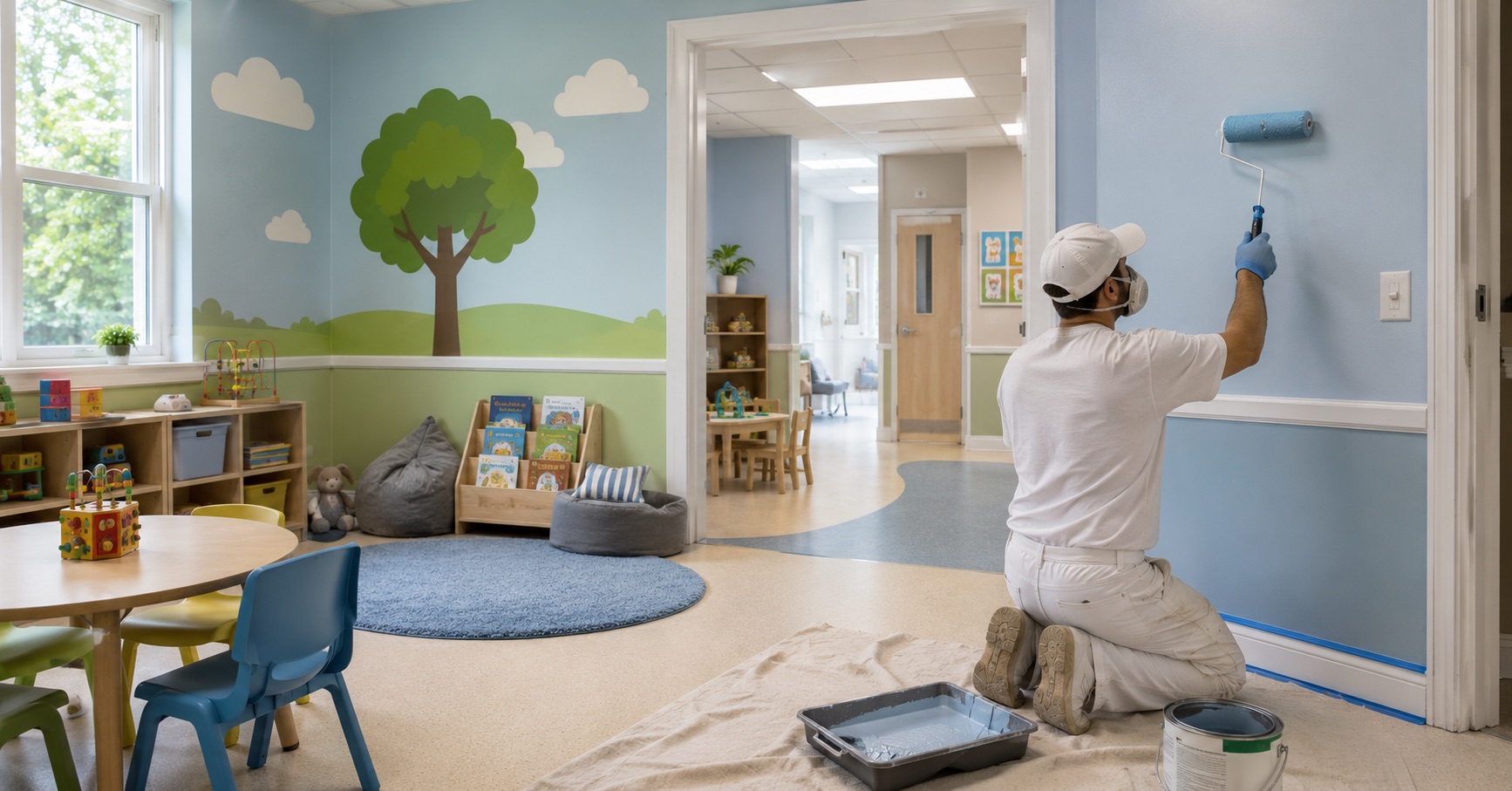
When a daycare director or pediatric practice manager calls about painting, color is rarely the first concern. The real questions are whether the facility can remain open, what rules apply, what product documentation will be available, and who decides when a room can return to use.
Those questions cannot be answered by promising “zero VOC,” saying the crew uses lead-safe methods, or assuming an overnight window solves everything. Each phrase sounds reassuring. None of them, alone, establishes that the project is compliant or that a room is ready for children.
AllBright Pro Painting treats the facility walkthrough as a planning meeting before it treats the space as a paint job. Building age, occupancy, surface condition, work-zone separation, ventilation, cleaning, and operating hours determine the scope. The facility’s licensing and clinical authorities retain the decisions that belong to them.
That division of responsibility is not a disclaimer added at the end. It is how the project stays within the authority of everyone involved.
“Child-Occupied Facility” Is a Technical EPA Definition
In ordinary conversation, any daycare or pediatric office may sound like a child-occupied facility. Under the EPA Renovation, Repair and Painting Rule, the term has a specific definition.
EPA defines a child-occupied facility as a building, or a portion of one, constructed before 1978 and regularly visited by the same child under age six on at least two different days in a week. Each visit must last at least three hours, the combined weekly visits must total at least six hours, and the combined annual visits must total at least 60 hours. The definition can include childcare centers, preschools, and kindergarten classrooms. It also limits which common areas and exterior sides are included. The EPA child-occupied facility definition controls over a contractor’s summary.
That means the label over the front door does not settle the question.
- A daycare in a pre-1978 building may readily meet the definition because the same young children attend repeatedly.
- A pediatric office is not automatically covered simply because it treats children. EPA says a healthcare facility is covered if it meets the child-occupied facility definition.
- A newer addition and an older original wing may require different questions.
- A hallway children only pass through may not be treated the same as a restroom they routinely use.
The facility should document the construction date, the spaces included in the proposed work, and the relevant child-visit pattern before the facility and contractor determine which paint-work requirements may apply and which questions need qualified guidance.
Building Age Starts the Lead Review; It Does Not Finish It
A pre-1978 date is a screening fact, not a complete lead determination. The project still needs to identify the portion of the building, the painted components, the intended disturbance, and any valid testing or records that affect the rule’s application.
Before pricing surface preparation, the walkthrough should answer four questions:
- Was the affected building or portion constructed before 1978?
- Does the affected area meet EPA’s definition of a child-occupied facility?
- Will scraping, sanding, repair, removal, or another part of the scope disturb painted surfaces?
- What existing lead inspection, risk assessment, testing, or renovation documentation can the facility produce?
Do not replace those questions with “there is probably no lead under the newer paint.” Newer topcoats do not identify the layers beneath them. Do not replace them with “all pre-1978 painting is automatically the same,” either. The scope and the rule have to be matched accurately.
EPA’s RRP program guidance distinguishes ordinary renovation work from lead abatement, and the programs carry different purposes and certifications. A repaint should not quietly turn into an unsupported abatement claim. If the facility needs lead inspection, risk assessment, or abatement, that work belongs with appropriately qualified providers under the applicable program.
Lead-Safe Practices and Firm Certification Are Not Interchangeable
This is the most important contractor-screening point on the page.
EPA states that covered renovations in child-occupied facilities must be performed by a lead-safe certified renovation firm using certified renovators trained in lead-safe work practices. Containment language, dust-control equipment, or a crew member’s past training does not substitute for current firm certification.
For a covered project, the facility should:
- Ask for the firm’s current certificate and identification number.
- Confirm that a certified renovator will be assigned as required.
- Verify the firm through the EPA Lead-Safe Certified Firm search.
- Require the applicable education, work-practice, cleaning-verification, and recordkeeping steps to be identified before work begins.
This test applies to every bidder, including AllBright Pro Painting. This article does not represent itself as proof of certification. If current documentation for AllBright Pro Painting cannot be produced and independently verified for a covered scope, the facility should not award that covered work to AllBright Pro Painting.
That is stricter than saying a crew “follows the protocol,” and it should be. EPA’s guidance for childcare operators tells facilities to hire only a lead-safe certified firm for covered work and to ask for proof.
A Zero-VOC Label Is One Product Fact, Not a Reopening Decision
The old version of this article treated zero VOC as the starting answer and added GREENGUARD as an extra assurance. That was too simple for a child-centered space.
EPA’s school indoor-air guidance notes that low-VOC and zero-VOC coatings vary in composition and performance and may still contain or emit compounds a facility does not want. The same guidance recommends considering overall composition, installation, maintenance, and available manufacturer certifications or test data. See EPA’s paint and material-selection guidance for schools.
The product review should therefore identify the exact:
- Manufacturer and product line
- Color and colorant system
- Primer, patching compound, caulk, and other wet-applied materials
- Product data sheet and current safety data sheet
- VOC information for the specified configuration
- Third-party emissions certificate, if the facility requires one
- Label precautions, ventilation instructions, and application limits
- Cure and cleaning guidance relevant to the facility’s maintenance routine
If a product is marketed as zero VOC, verify what that statement covers. Do not translate it into “odorless,” “emission-free,” “safe for every occupant,” or “ready for children as soon as it feels dry.” Those are different claims.
For facilities serving children with individual medical needs, the painter should not make a clinical decision from a coating label. The director, practice manager, parent, or clinician who owns that decision should review the exact documentation as appropriate.
Ventilation and Reentry Need Their Own Plan
Product selection does not eliminate the need to control exposure during and after application. EPA’s Healthy Indoor Painting Practices recommends reading and following product precautions, supplying outdoor air, exhausting vapors outside, and keeping young children and people with breathing problems away from paint vapors.
The facility-specific ventilation plan should identify:
- Which work areas will be isolated from occupied rooms.
- Whether the building’s HVAC system shares return air across those zones.
- How outdoor air and exhaust will be provided without sending air into another occupied area.
- How the work area will be secured from children, patients, staff, and visitors.
- Which label, facility policy, or clinical authority determines reentry.
- Who inspects and releases the room before normal use resumes.
“We will paint after closing and ventilate before morning” is not a complete plan. The available time may be enough for one product and one space but inadequate for another. Weather, air exchange, room volume, coating system, and occupant sensitivity can change the decision.
Dry-to-touch time is also not a universal reentry or cleaning time. The difference between drying, recoating, handling, and full cure is addressed separately in how long paint takes to cure versus dry. This page stays with facility planning: follow the exact product documents and let the appropriate facility authority control reopening.
Durability Must Match the Facility’s Cleaning Routine
Daycare walls encounter hands, toys, food, art materials, and repeated cleaning at child height. Pediatric spaces add their own cleaning products and room-reset procedures. A coating that cannot tolerate the actual maintenance routine may soften, polish, stain, or wear prematurely.
“Washable” is not enough detail for the specification. Before selecting the finish, the facility and contractor should compare:
- The cleaners and disinfectants actually used
- Their concentration and required contact time
- How frequently each surface is cleaned
- Whether the manufacturer lists chemical-resistance or cleaning limitations
- The coating’s cure requirements before routine cleaning begins
- The visibility of touch-ups under the room’s lighting
Higher sheen can improve cleanability in some systems, but it can also reveal wall defects and create glare. A lower-emitting product may not be the best match for a harsh disinfectant. The selection has to satisfy indoor-air, appearance, maintenance, and durability requirements together.
When AllBright Pro Painting proposes a coating system, the written estimate should identify the products and the paint-side documents requested for review. The facility decides whether those documents satisfy its environmental, clinical, procurement, or licensing criteria.
The Operating Calendar Shapes the Work Sequence
The best coating specification is useless if the project forces a center to close unexpectedly or returns an unfinished room to service. Scheduling starts with the occupancy calendar and works backward into paintable zones.
| Scheduling approach | When it can work | Condition that must be resolved first |
|---|---|---|
| After-hours work | A small area can be completed, cleared, and evaluated inside a closed window | Ventilation, cure stage, security, and documented morning handoff |
| Room-by-room rotation | The facility has spare capacity and can keep children or patients out of the active zone | Separation, circulation routes, shared HVAC, and the facility’s occupancy limits |
| Weekend or holiday block | A larger connected area needs uninterrupted access | Building access, alarm procedures, drying and reentry window, final cleaning |
| Planned seasonal closure | The facility can reserve its largest scope for scheduled downtime | Material lead time, staff access, other maintenance trades, reopening inspection |
A daycare may need to preserve classroom ratios and licensed capacity while one room is unavailable. A pediatric practice may need to protect appointment flow while keeping work away from occupied clinical areas. Those are operational constraints supplied by the facility, not assumptions the painter should make.
The daycare or pediatric office should also determine how parents, staff, patients, neighboring tenants, and building management will be notified. AllBright Pro Painting can plan its access and work zones around that communication plan; it does not decide who the facility must notify.
For a medical practice, patient privacy, records access, landlord coordination, and HIPAA questions belong to the separate medical office repainting and tenant-coordination article. Repeating those issues here would blur two different decisions. This article owns the child-safety, product-documentation, lead-screening, and reentry side.
Where AllBright Pro Painting’s Job Ends
A painter who promises to “handle compliance” is claiming authority that belongs to regulators, facility leadership, and, in some cases, clinical or environmental professionals. A facility also should not leave paint-side planning undefined and assume its licensing consultant will write the contractor’s scope.
AllBright Pro Painting owns the paint-project work it agrees to perform:
- Inspecting accessible surfaces and documenting the proposed painted scope
- Asking the building-age and occupancy questions that affect lead review
- Providing current contractor credentials required for covered work
- Identifying products, supporting documents, and requested substitutions
- Planning work zones, access, protection, ventilation, cleanup, and handoff
- Coordinating the sequence with the operating calendar supplied by the facility
- Recording changes to product, schedule, or scope before carrying them out
The facility owns the decisions and records within its authority:
- Confirming which licensing, accreditation, health, procurement, and building rules apply
- Giving accurate building, occupancy, cleaning, and operating information
- Approving products under its own policies
- Setting exclusion and reentry requirements for children, patients, and staff
- Securing records, medication, equipment, and restricted rooms
- Communicating with parents, employees, patients, regulators, landlords, or other stakeholders
- Retaining the documentation its licensing or compliance program requires
For Tennessee childcare operations, the Tennessee Department of Human Services childcare resources identify licensed agencies and direct providers to current state resources. A contractor’s blog does not replace the agency’s licensing consultant or the current rules.
The responsibilities meet at the written project plan. Neither side should silently inherit the other’s decisions.
What the Written Scope Should Show
The proposal does not need an invented universal “child-occupied facility clause.” It needs project-specific answers that a director or practice manager can verify.
Before signing, look for:
- The rooms, surfaces, and exclusions in the scope.
- The construction-date information used during lead screening.
- The RRP determination process and current certification evidence where applicable.
- The exact primer, paint, color, and sheen, with supporting documents.
- The cleaners or maintenance requirements considered during selection.
- The active work zone, containment, access, and storage plan.
- The ventilation method and who controls reentry.
- The daily or phase handoff required before operations resume.
- The schedule tied to actual operating hours and closure dates.
- The process for documenting concealed conditions, substitutions, and scope changes.
That list makes the proposal commercially useful. It allows the facility to compare more than price and allows the contractor to price more than square footage.
The interior commercial painting service page explains the broader surfaces and commercial painting service AllBright Pro Painting provides. This article has a narrower purpose: define the safety, documentation, authority, and scheduling questions that a child-centered facility must settle before work begins.
The Bottom Line
A daycare or pediatric office repaint is not made compliant by a product label, a crew’s verbal promise, or the fact that work happens after hours. Start with the EPA definition. Determine whether the proposed area and disturbance fall under the RRP Rule. Verify the firm’s current certification when the rule applies. Review the exact coating documents. Build ventilation, cleaning, and reentry into the schedule. Keep licensing and clinical decisions with the authorities that own them.
AllBright Pro Painting can walk the facility, document the paint scope, record the questions the facility still must resolve, and build the work sequence around real operating hours. To start that review, schedule a commercial painting estimate or call 615-987-8011.
The first useful outcome may be an estimate. It may also be a list of documents or decisions the facility needs before an estimate can responsibly become a project. In a child-centered space, identifying that boundary is part of doing the paint job correctly.